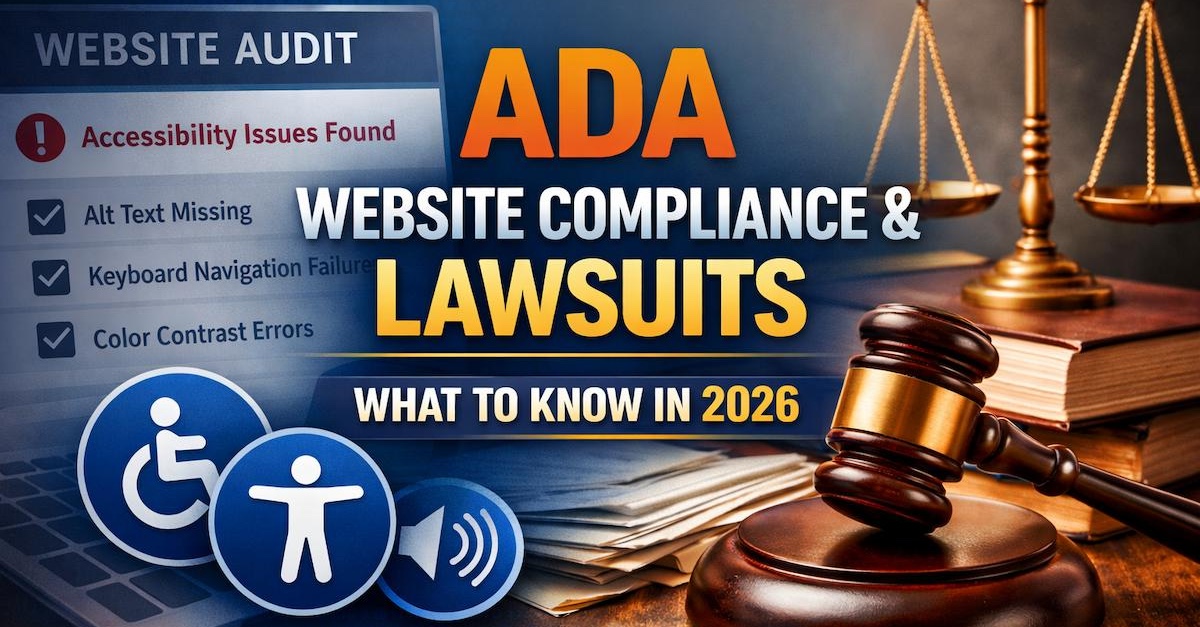
If you own or manage a business website in 2026, ADA website compliance is no longer optional—it’s becoming a major legal risk.
Over the past several years, lawsuits claiming that websites are inaccessible to people with disabilities have surged across the United States, and the trend is accelerating. Businesses of every size—from e-commerce startups to regional service companies—are now facing legal action for failing to make their websites accessible.
For companies that rely on their website for marketing, sales, or lead generation, the message is clear:
Accessibility is now both a legal requirement and a business best practice.
This guide explains what’s happening in the courts, what the law requires, and what website owners should do to protect themselves.
ADA Website Lawsuits Are Increasing Rapidly
Digital accessibility lawsuits have grown significantly in the past few years.
- More than 5,100 digital accessibility lawsuits were filed in 2025, a roughly 20% increase from 2024.
- In the first half of 2025 alone, 2,014 ADA website accessibility lawsuits were filed, representing a 37% year-over-year increase.
- In 2024, 2,452 federal lawsuits specifically targeted website accessibility barriers.
These lawsuits typically claim that a company’s website prevents individuals with disabilities—particularly those using screen readers—from accessing goods or services online.
Most cases are filed under Title III of the Americans with Disabilities Act, which requires businesses that serve the public to provide equal access to their services.
Courts have increasingly interpreted that requirement to include digital access to websites and mobile apps.
Real Examples of ADA Website Litigation
ADA website lawsuits are no longer hypothetical—they’re affecting real companies across many industries.
Fashion Nova Accessibility Lawsuit
Online retailer Fashion Nova faced a major class action lawsuit alleging that blind users could not navigate the website using screen-reader technology. The case resulted in a proposed $5.15 million settlement related to accessibility barriers.
Domino’s Pizza Case
In a widely cited earlier case, Domino’s Pizza was sued because visually impaired customers could not order online using screen readers. The U.S. Supreme Court allowed the lawsuit to proceed, reinforcing that websites connected to physical businesses may fall under ADA requirements.
Growing Demand Letter Campaigns
Legal firms are increasingly sending ADA demand letters to businesses alleging website accessibility violations. Many companies settle these claims because defending them in court can cost far more than remediation.
Why Small and Mid-Sized Businesses Are Being Targeted
Many business owners assume ADA lawsuits only affect large corporations.
That assumption is incorrect.
Accessibility lawsuits frequently target:
- Local service businesses
- Retail websites
- Restaurants and hospitality companies
- Healthcare providers
- Professional service firms
In fact, e-commerce sites account for the majority of lawsuits, representing roughly 70% of accessibility claims in 2025.
Smaller businesses are often targeted because they:
- Lack accessibility testing
- Use outdated website platforms
- Install plugins or themes that are not accessible
- Assume accessibility rules only apply to government websites
New ADA Website Rules Are Also Coming
In addition to private lawsuits, federal regulators are clarifying accessibility standards.
The U.S. Department of Justice has adopted WCAG 2.1 Level AA as the technical standard for website accessibility in government services, with compliance deadlines beginning in April 2026 for larger public entities.
While these rules apply directly to government websites, they strongly influence how courts evaluate accessibility in private-sector lawsuits.
In practice, this means businesses are expected to design websites that meet WCAG 2.1 AA guidelines.
What Makes a Website ADA Compliant?
ADA compliance is largely based on the Web Content Accessibility Guidelines (WCAG).
Key accessibility requirements typically include:
- Screen Reader Compatibility
Websites must work with assistive technologies used by visually impaired users.
This includes:
- Proper HTML structure
- ARIA labels
- Accessible navigation
- Alt Text for Images
All meaningful images must include descriptive alternative text.
- Keyboard Navigation
Users must be able to navigate the website without a mouse.
- Color Contrast
Text must have sufficient contrast for users with vision impairments.
- Accessible Forms
Forms must include proper labels, error messaging, and screen-reader compatibility.
What Happens if Your Website Is Not Accessible?
Businesses typically face three stages of risk:
- Demand Letter
An attorney contacts the business claiming accessibility violations.
- Settlement Negotiation
Most cases settle quickly, often costing $5,000–$25,000 plus remediation costs.
- Lawsuit
If the issue isn’t resolved, a formal ADA lawsuit may follow.
Legal fees can quickly exceed $50,000 or more if the case proceeds to litigation.
What Website Owners Should Do Right Now
The best defense against ADA lawsuits is proactive compliance.
Business owners should take the following steps:
- Conduct an Accessibility Audit
Have your website tested against WCAG 2.1 AA standards.
This includes:
- automated accessibility scanning
- manual testing
- screen reader testing
- Fix Accessibility Issues
Remediate problems such as:
- missing alt text
- inaccessible navigation
- improper form labels
- poor color contrast
- Add an Accessibility Statement
An accessibility policy demonstrates good-faith compliance.
- Ongoing Monitoring
Accessibility is not a one-time fix—websites require ongoing monitoring as content changes.
How DigitalHipster Helps Businesses Avoid ADA Website Lawsuits
At DigitalHipster, we help businesses design and maintain websites that meet modern accessibility expectations.
Our accessibility services include:
- ADA website audits
- WCAG 2.1 remediation
- accessible WordPress development
- accessibility monitoring and reporting
- accessible design best practices
If your website hasn’t been reviewed for accessibility recently, now is the time.
Ignoring accessibility issues today could lead to expensive legal problems tomorrow.
Protect Your Website from ADA Risk
ADA website lawsuits are increasing every year, and the legal landscape is evolving quickly.
Taking proactive steps today can:
- protect your business from lawsuits
- improve user experience
- expand access to more customers
- strengthen your brand reputation
If you want to ensure your website meets modern accessibility standards, DigitalHipster can help.
👉 Learn more about our Web Design Services
Or contact us today for a professional ADA website compliance review.