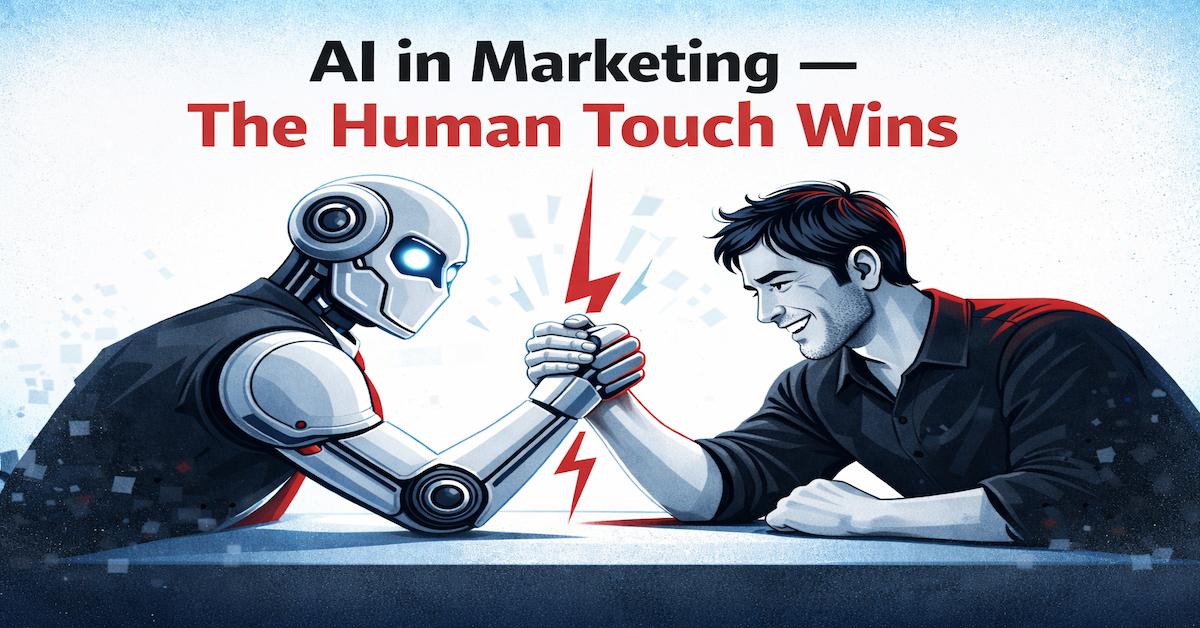
Congratulations, everyone. We’ve officially crossed through Peak AI Hype and landed squarely in the “wait, why does this feel so hollow?” era of marketing. Brands are pumping AI-generated content into every channel at industrial scale — blogs that read like a confident robot wrote them, ads that are technically flawless and emotionally empty, social posts that are grammatically perfect and completely forgettable.
And audiences? They notice. Turns out, empathy isn’t a prompt.
Here’s the real story about AI in marketing in 2026: it isn’t replacing the marketers who understand people. It’s exposing the ones who never really did.
The AI Content Flood Is Real (and Kind of Exhausting)
Let’s not pretend AI hasn’t changed the game — it absolutely has. Generative AI tools have slashed production timelines, made personalization at scale actually achievable, and handed small businesses capabilities that once required a full agency retainer. That’s legitimately useful.
But here’s what happened when every brand got those same capabilities simultaneously: the internet got louder and blander at the same time. When AI-generated content becomes the default output, the entire baseline moves down. Every blog post sounds the same. Every ad reads the same. Every email follows the same structure.
The brands that are thriving right now aren’t the ones who automated the most. They’re the ones who used AI to work smarter while keeping humans in the storytelling seat.
What AI Actually Can’t Do (Spoiler: It’s the Important Stuff)
AI is remarkably good at pattern recognition, generating variations quickly, analyzing data, and producing coherent text at scale. Nobody’s debating that.
What it can’t do is know what it feels like to be your customer. It can’t carry the cultural context of your local market. It can’t feel the gut instinct that says “this is off-brand” before a focus group confirms it six months later. It can’t replace the judgment call a seasoned marketer makes about tone, timing, and audience trust.
The highest-value marketing work has always been strategic and relational: understanding who you’re talking to, why they should care, and what makes your brand’s voice distinct. AI is a production accelerant. It is not a brand strategist, and confusing the two is where most companies are making expensive mistakes.
The brands winning in 2026 aren’t choosing between AI and humans. They’re using AI to execute faster while their people focus on the one thing a language model genuinely cannot replicate: meaning.
The Brands That Got Publicly Roasted for Going Full AI
In 2025, several household-name brands found out the hard way that audiences have finely tuned BS detectors. High-profile AI-generated campaigns were publicly criticized — not because the execution was technically poor, but because people could feel the absence of a human being behind them. They felt transactional. Manufactured. Cold.
Meanwhile, brands that leaned into real voices, authentic storytelling, and creative risk-taking with actual human instinct behind it? They stood out in the feed like a real conversation at a networking event full of people reciting their elevator pitches.
It’s not that consumers are anti-technology. They’re anti-hollow. And they can tell the difference faster than any algorithm can predict.
The Winning Formula: AI Does the Lifting, Humans Do the Thinking
The marketers and agencies building durable competitive advantages right now have figured out the actual hybrid model — and it’s not complicated:
AI handles: Research, keyword analysis, content variation testing, audience segmentation, reporting, and production efficiency. Things that benefit from speed and scale.
Humans handle: Brand voice, strategic positioning, creative judgment, emotional resonance, community relationships, and anything that requires genuine understanding of another human being.
This is why having a strategic digital marketing partner matters more now than it did five years ago — not less. The tools are commoditized. The thinking isn’t.
It’s also why social media marketing still requires human instinct at its core. Trends move fast, culture is nuanced, and the difference between a post that lands and one that backfires is rarely a data problem. It’s a judgment problem. And AI doesn’t have judgment — it has probability.
What This Means for Your SEO and Content Strategy
If you’ve been watching your organic traffic get weird over the past year, AI Overviews in Google search are a big reason why. Search is no longer just about ranking — it’s about being cited. And to be cited by AI-generated summaries, your content needs to be genuinely authoritative, original, and useful — not churned out at scale for keyword density.
We’ve written about this in depth: how to optimize for AI Overviews is a completely different game than traditional SEO, and the brands getting it right are the ones producing content with genuine expertise and a distinct point of view. That’s a human job.
On the paid side, Google Ads strategy has also evolved significantly — AI-powered bidding and targeting handles a lot of the mechanical optimization now. But writing ad copy that actually connects with a real person? Still requires a real person who understands what moves them.
And if you’re trying to figure out where your SEO strategy fits into an AI-dominated search landscape, that’s not a question you want to answer with a generic AI tool. That’s a conversation worth having with people who actually understand your market.
The Human Touch Is Your Competitive Advantage Now
Here’s the counterintuitive truth about the AI content flood: it’s actually good news for skilled marketers and brands with a real identity.
When everyone has access to the same AI production capabilities, the differentiator becomes what the AI can’t replicate. Originality. Perspective. Cultural intelligence. Genuine relationships with an audience that was built over time, not generated overnight.
The marketers who will thrive in this environment are the ones who treat AI as the excellent production tool it is — and spend their freed-up time doing the high-value human work that actually builds brands. And the businesses that will win are the ones who still invest in real marketing strategy rather than outsourcing their entire presence to a chatbot and calling it a day.
The Bottom Line
AI in marketing is not a threat to good marketers. It’s a filter. It’s weeding out the volume-over-quality approach and making genuine expertise and human creativity more valuable than they’ve been in years.
The brands that understand this — and build their marketing around it — are going to look very smart in about 18 months.
The ones that went all-in on “just use AI for everything” are going to be wondering why their engagement metrics keep dropping while their content calendar is fuller than ever.
If you’re not sure which camp your strategy falls into, let’s have a conversation. That’s still a human thing we do really well.